- Pace74 · rather frantic
- Each hour lasts under two minutes. Three or four Things creep in at once from the corners of the room, and you have to keep sweeping. The ticking alarm clock is the metronome, speeding up from 120 to 150 BPM between 1:00 and 5:59 a.m.
- Difficulty49.8 · in between
- When a Thing touches the bed, the child sits up, the flashlight falls, and you start the hour over (one or two minutes lost). After two failures in the same hour, one Thing stops coming, and the game never says so.
- Tone69.2 · rather unsettling
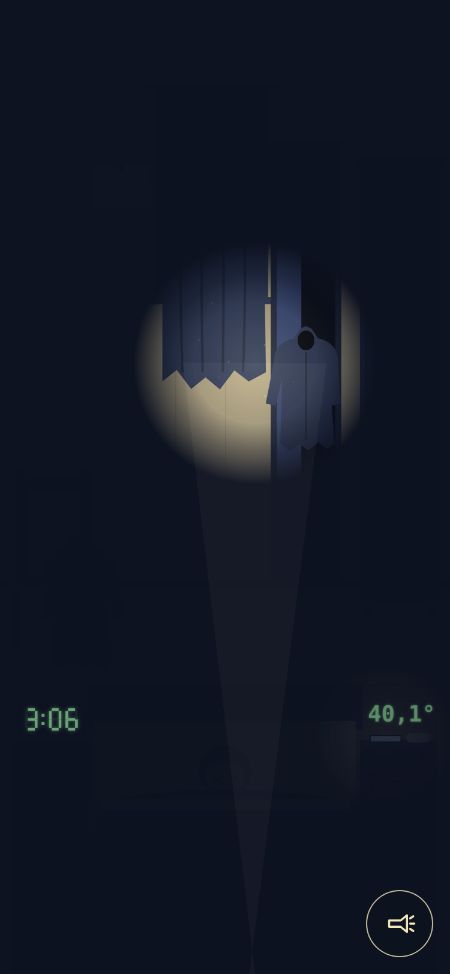
- The familiar things of a bedroom (the coat on the chair, the wardrobe, the curtain, the space under the bed) move as soon as you stop looking at them, and something rustles on your left, then your right. Nobody screams, and no monster is ever seen whole. The ending is tender: the light comes back, and it was only a bedroom.
- Story26 · rather silent
- The text comes to about eight lines, all part of the room: the phone screen (“Power outage · back on by 6:00”), the thermometer (39.4, then 37.1), the alarm clock, and five sentences the child whispers between the hours (“Will you stay?”, “If you turn it off, they can't see.”). The drawing pinned to the wall fills in hour by hour and tells the rest.
- Scale21.2 · rather intimate
- A child's bedroom, a chair, a bed and a single night, seen from the parent's chair. You never leave the room.
- Form64.4 · in between
- The flashlight is a familiar verb, but each hour adds a rule nobody states: the wardrobe only moves when you light it, the beam fades when it stays still, and what is under the bed advances as long as the flashlight is on. You learn them by failing, and one of the child's sentences is the clue to the strangest.
- Look30.8 · rather spare
- Three colors: an ink blue-black, the cream yellow of the beam and the green of the child's wax crayons. Objects are simple flat shapes, revealed only inside the circle of light, and the rest of the screen is almost empty.
The theme
On a new-moon night, the power is out across the whole building. A parent sits up with a feverish child, a flashlight in hand. In the dark, the coat, the wardrobe, the curtain and whatever is under the bed creep toward the bed. At 6 a.m. the light comes back, and it was only a bedroom.
The mechanics
A fixed view from the chair. You aim the beam with the mouse, a finger or the arrow keys; space, click or tap turns the flashlight on and off. What is lit freezes and backs away; what stays in the dark creeps closer. Each hour adds a rule nobody states: the wardrobe only opens when you light it, the beam fades if it stays still, and what is under the bed advances as long as the flashlight is on. If a Thing touches the bed, you start the hour over.
Palette
Ink blue-black #0d1220, cream beam #f3e6b8, crayon green #6fae7a for the child's drawing, the alarm clock and the thermometer. Flat slate shapes. Caveat, a child's handwriting. Tense, warm at the center, cold at the edges.