- Pace62.4 · in between
- Le vent ne laisse jamais la main au repos : une rafale, une mouette ou un creux arrive toutes les deux ou trois secondes, et il faut tirer ou relâcher la ficelle. Seules la première minute sur la dune et la descente finale au crépuscule laissent respirer.
- Difficulty54.4 · in between
- Si la ficelle casse ou si le cerf-volant tombe dans la mer, on reprend au début de l'altitude en cours, soit deux minutes au plus, et on garde les cerfs-volants perdus déjà rattrapés. Après deux chutes dans la même étape, sans le dire, les rafales s'annoncent plus tôt et la ficelle tient un peu plus.
- Tone62.2 · in between
- L'après-midi est venteux et lumineux. Mais là-haut volent des cerfs-volants que personne ne tient, dont la ficelle descend vers une plage vide, et l'un d'eux remonte contre le vent. La fin console : on ramène tout le monde avant la nuit.
- Story28.8 · rather silent
- On ne trouve aucune phrase hors du monde. On lit seulement ce qui est cousu sur les pièces de la voile (des initiales et les années des réparations : 1961, 1974, 1988, 2003), l'étiquette de la bobine et la même année brodée sur chaque cerf-volant perdu. On comprend l'histoire en reconnaissant les dates.
- Scale33.8 · rather intimate
- Il n'y a qu'une personne, une dune et une ficelle. Le ciel est grand, mais tout tient au bout d'une seule main, sur un après-midi qui va de 15 h au crépuscule.
- Form62.7 · in between
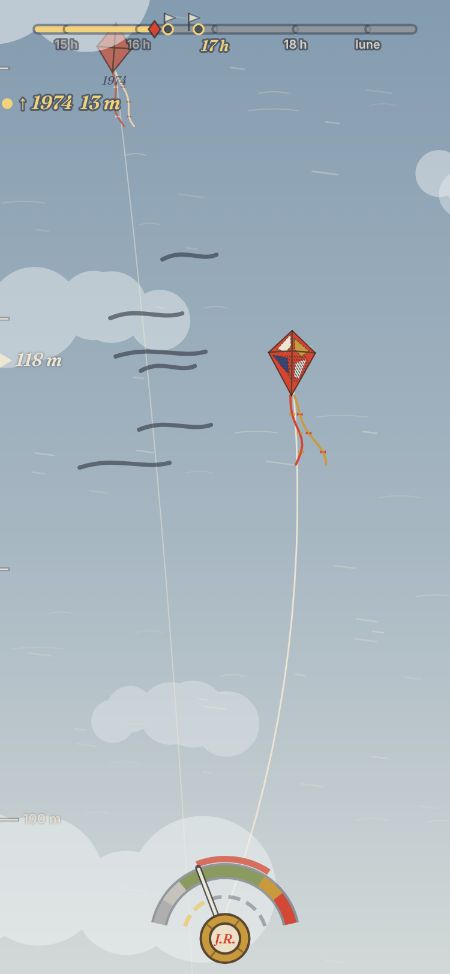
- La base est familière : on tient pour tirer et on lâche pour donner du mou, comme une canne à pêche à tension. L'étrange, c'est que la ficelle chante. Sa note monte avec la tension, et pour rattraper un cerf-volant perdu, il faut tenir la même note que lui. Dans les nuages, on ne vole plus qu'à l'oreille.
- Look48 · in between
- L'image est à mi-chemin : un ciel en dégradé qui change avec l'heure, trois couches de nuages, des oyats qui se couchent sous la rafale, du sable que le vent emporte, des mouettes, et une voile rapiécée de tissus différents avec sa queue de rubans. Le décor est riche sans être saturé, et il garde de l'air au-dessus du cerf-volant.
The theme
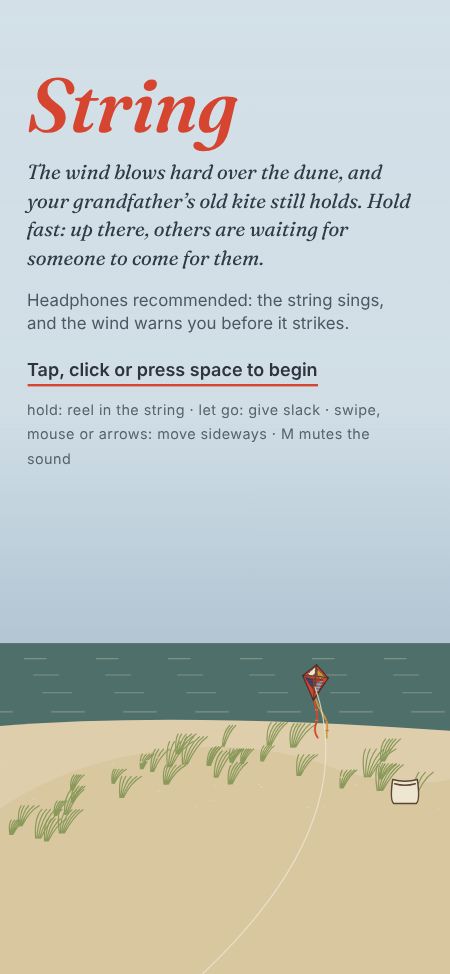
An October Wednesday, from 3 pm to dusk, on a dune of the Côte d'Opale in a strong west wind. Someone is flying their grandfather's old kite, patched four times, each patch stitched with a year (1961, 1974, 1988, 2003). Up there, with no one at the other end, the kites lost in those years are still flying. You climb to fetch them one by one. At dusk the wind drops and you bring them all down to the sand, under the first crescent moon.
The mechanics
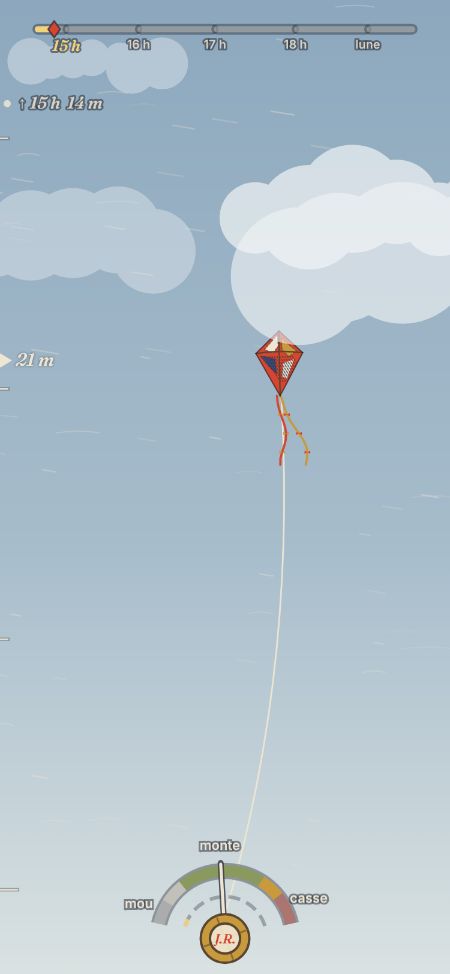
Vertical view; the camera follows the altitude. Holding (click, space or a finger down) reels in the string: the kite climbs and the tension rises. Letting go gives slack. Tension reads on an arc gauge above the reel: in the green band you climb, above 1 the string snaps, too long below 0.15 the kite stalls. You steer sideways with the pointer, a finger or the arrow keys. Gusts, announced by a whistle and wind lines coming from the left, suddenly add 0.45 tension; lulls let it fall back. Gulls send the sail spinning and cost altitude. The string sings a note that rises with the tension: to catch a lost kite, you draw close and hold its note (the gold ring on the gauge) until its string winds around yours. A bar at the top of the screen shows the hours, where you are and the checkpoint flags. A fall sends you back to the last flag passed (one every third of an hour, and wherever you caught a lost kite), with the lost kites already caught.
Palette
Grey-blue sky #9fb7c9 turning apricot #e8a87c, then plum #5b3f5e at dusk. Verdigris sea #4f6f6a, sand #d9c7a0, marram grass #8a9a5b. Vermilion sail #d6452f patched with ochre #c99a3b, indigo #3b4a7a and unbleached canvas #efe6d2. Off-white string that glows pale gold when the note is true. Fraunces italic for the title and the stitched years. Bright, windy, joyful below and strange up high.