- Pace36.8 · in between
- You hold, you let go, you hold again: a rhythm set by the bear's glances, with a window of nine seconds per round. Never a pure reflex test, more a slow tension that tightens a little at each board.
- Difficulty57.4 · in between
- Being caught costs the push and gives Basile two squares; four catches, or Basile reaching the end first, and the board starts over. Each failure quietly softens the die a notch, so you can always get through.
- Tone52.8 · in between
- A conspiratorial little game, warm and teasing: nobody is hurt, everybody cheats. A hint of unease in the third board, when Basile's hand starts creeping towards his pawn.
- Story41.6 · in between
- A few short bubbles from Lila and Basile, one line each, and a last line at the end. The story is the race itself, and the twist that Lila knew.
- Scale64.6 · in between
- The game starts on a kitchen table and the camera keeps pulling back: the town, Europe at night, the whole solar system. Each win widens the board by a notch.
- Form49.7 · in between
- Everybody knows the race game. The invented part is the verb: you push the pawn by holding, and you read the bear's glances to know when to let go.
- Look46.2 · in between
- Painted gouache plates for the four boards, Lila's faces, the bear and the hands, on top of a clean board drawn in code. Dense enough to pull you in, flat enough that the pawns always read.
The theme
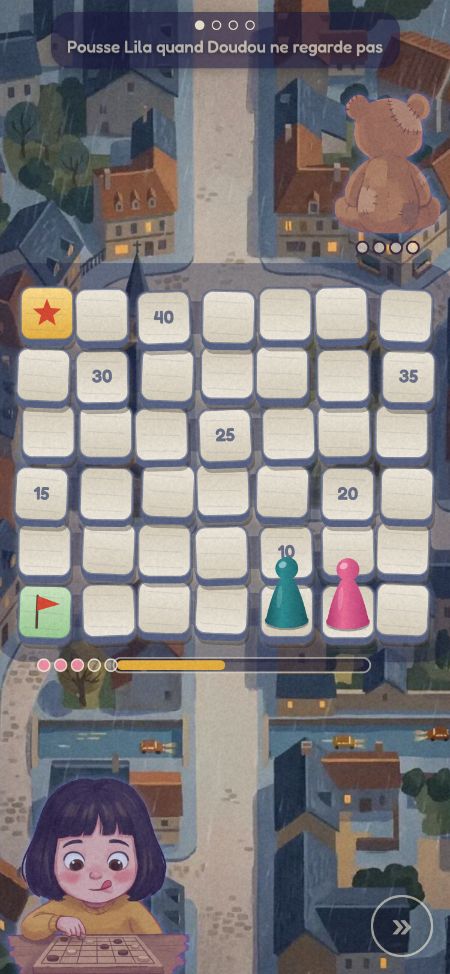
One autumn evening, Lila, six, plays a race game against her cousin Basile, who has a loaded die and a teddy bear, Doudou, to keep watch. You help her in secret. The game grows with every win: the kitchen table, the town in the rain, Europe seen at night, then the solar system. At the end you find out Lila saw everything, and that she cheats too.
The mechanics
Each round the dice move the pawns (a small die for Lila, a loaded one for Basile), then a nine-second window opens: hold your finger, the mouse or Space to push Lila's pawn up to four squares, and let go when Doudou turns round (he warns you with a sideways glance, sometimes for nothing). If you're caught the pawn slides back and Basile gains two squares; four catches or a win for Basile and the board starts again. From the third board on, Basile cheats too: tap his pawn while his hand reaches for it.
Palette
Tablecloth linen #f1e6cf, tomato #d9482b, mustard #e8b23a, teal #2c7a7b, night indigo #1b2150, pawn pink #ef8fa3. Fifties picture-book gouache, flat colour and dry-brush grain. Fredoka and Patrick Hand. Conspiratorial, warm, a little feverish, with a big sky opening up.